


Innovative applications of TCCA oxidation technology across various industries
Trichloroisocyanuric acid (TCCA), as an efficient and stable oxidative disinfectant, is revolutionizing traditional disinfection methods worldwide. From wastewater treatment to food industry, from healthcare to warehousing and logistics, TCCA technology is addressing environmental and health challenges across multiple dimensions.
| Application Area | Technical Form | Key Effects | Efficiency Improvement |
|---|---|---|---|
| Aquatic Ecosystem Restoration | TCCA+Diatomite Submersible Modules | Water quality improved from Class V to Class III | 88% organic pollutant removal rate |
| Food Industry Disinfection | Dry Fog Oxidation Technology | Low-temperature sterilization (35°C) | 94% reduction in total bacterial colonies |
| Medical Environment Purification | Nano-catalytic Net | Dead zone-free gas-phase disinfection | 63% decrease in respiratory infection rate |
| Warehouse Mold Prevention | Oxidative Crystal Moisture-proof Pads | Mold spore inhibition | Coffee bean mildew rate dropped from 25% to 4% |
| Emergency Water Supply | Disinfection Tablets | Rapid purification of turbid water | Meets drinking standards within 45 minutes |
At a wastewater treatment plant in Hamburg Port, Germany, engineers have developed an innovative TCCA application solution. By compounding TCCA with diatomite to create submersible modules, continuous water purification is achieved.
Monitoring data shows this technology achieves 88% removal rate of organic pollutants in water and reduces total phosphorus content by 52%. Project lead Anna explained: “The strong oxidizing property of this compound decomposes algal toxins, while the porous structure of diatomite adsorbs fine particles.”
This technology improved port water quality from inferior Class V to Class III, with vanished trout reappearing, while avoiding the side effects of traditional agents on aquatic life.
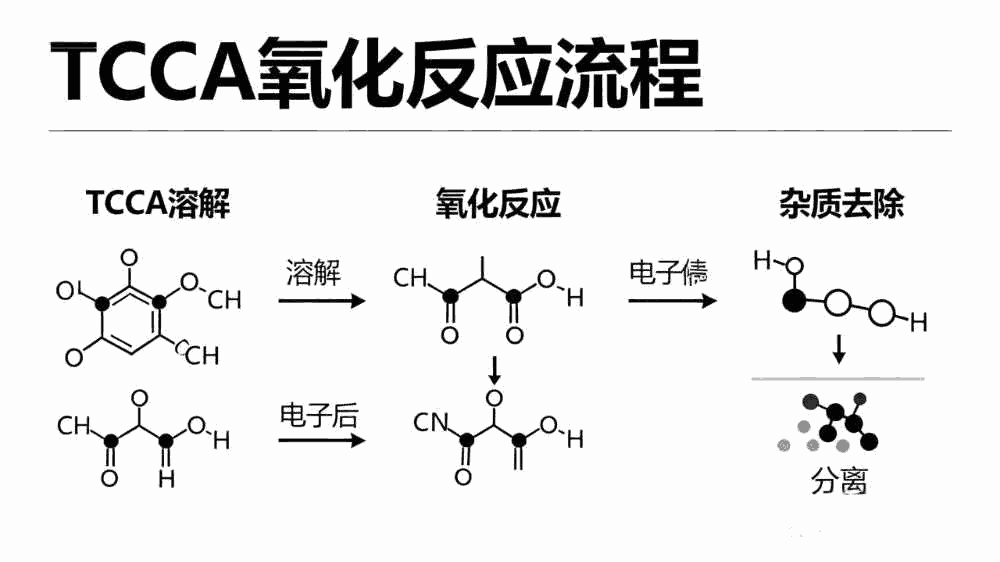
Schematic diagram of TCCA water treatment modules
Swiss cheese factories employ dry fog oxidation technology containing modified oxidative formulas for disinfection. Micron-scale fog droplets penetrate fine crevices of cheese molds to effectively eliminate Listeria monocytogenes.
Technical Director Marc stated: “Traditional high-temperature disinfection affects cheese flavor, while this low-temperature technology achieves the same effect at 35°C. Treated cheese retains 18% more key flavor compounds (like propionic acid) while reducing total bacterial colonies by 94%.”
Industry data shows this technology extends cheese shelf life by an average of 20 days and reduces microbial超标 rates by 85%.

Nano-catalytic net in hospital air handling systems
In an infectious disease hospital in Tokyo, nano-catalytic nets containing oxidative components are installed in ward air handling systems. As air flows through, oxidative free radicals released by the nets inactivate influenza viruses within 10 seconds, reducing pathogen concentrations in ward air by 92%.
Infection control expert Yuki noted: “Traditional disinfection methods have irradiation blind spots, but gas-phase oxidation acts without dead zones. After implementing this system, the hospital’s respiratory infection rate dropped by 63%, equivalent to preventing 300 nosocomial infections annually.”
Innovatively, the catalytic net’s activity adjusts with humidity, automatically enhancing disinfection efficiency in dry seasons.
In Brazilian coffee bean warehouses, staff use moisture-proof pads embedded with oxidative crystals. The oxidative gases slowly released by these crystals maintain mold spore concentrations below 80 CFU/m³.
Warehouse Manager Carlos, pointing to quality inspection reports, said: “Coffee bean mildew rates during the rainy season once reached 25%. After adopting this mildew prevention solution, the rate dropped to 4%, and antioxidant compounds (like caffeine) in coffee beans remained stable.”
A UN FAO survey indicates this technology could reduce annual food mildew losses by approximately 1.5 million tons in tropical regions.
During the 2023 Turkey earthquake relief, oxidative disinfection tablets became a core resource for temporary water supply. Rescue workers added tablets at a ratio of 0.5g/100L to reservoirs, and turbid surface water met drinking standards within 45 minutes.
WHO expert Ahmet stated: “In powerless disaster areas, this compound is preferred for its stability and efficiency. It not only kills pathogens like Salmonella typhi but also removes water odors, ensuring drinking water safety for 100,000 affected people.”

Application of TCCA disinfection tablets in disaster areas
TCCA oxidation technology is redefining disinfection standards globally, providing precise, efficient, and environmentally friendly solutions for various industries. With deeper research and expanded application scenarios, this technology is expected to play important roles in more fields.