

Trichloroisocyanuric acid (TCCA) is an important organochlorine disinfectant and oxidant. Its chemical formula is C₃Cl₃N₃O₃, and its molecular weight is 232.41. It typically appears as a white crystalline powder or granular solid with a strong, pungent chlorine odor.
As a representative of chlorinated isocyanuric acid compounds, TCCA has become a modern and upgraded alternative to traditional disinfectants such as liquid chlorine, bleaching powder and bleaching powder essence due to its high available chlorine content (up to 90% or more), stable storage, easy use, safety and high efficiency.
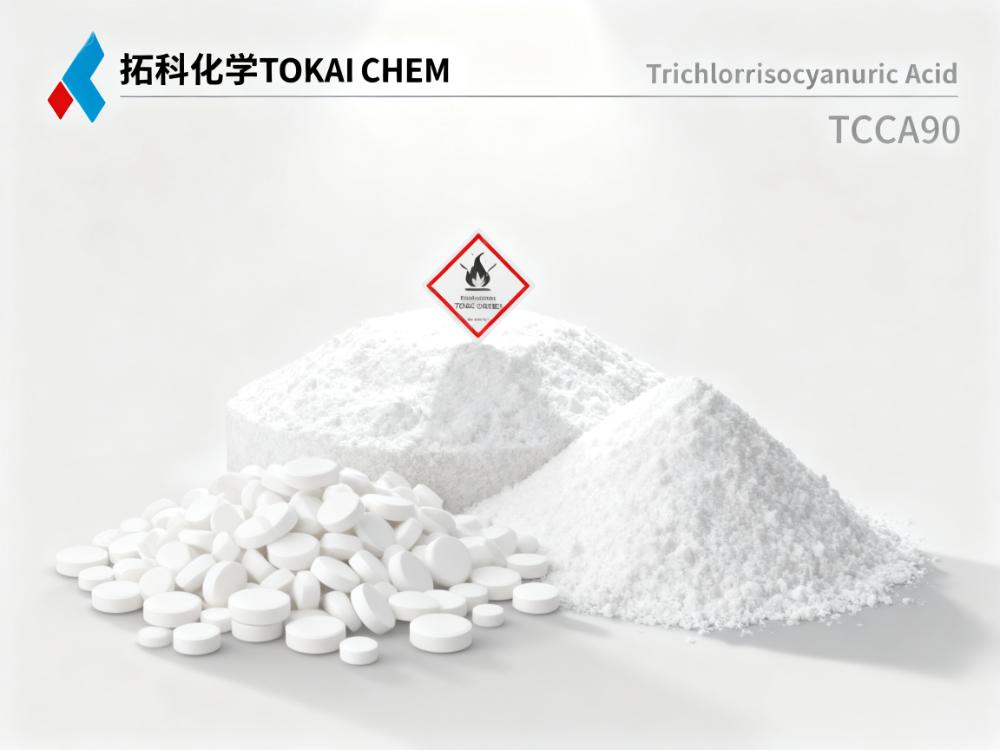
TCCA‘s success stems from its unique chemical properties. Below is a summary of its core properties:
| Property | Value/Description | Notes |
| Chemical Formula | C₃Cl₃N₃O₃ | – |
| Molecular Weight | 232.41 g/mol | – |
| CAS Number | 87-90-1 | CAS Registry Number |
| Available Chlorine Content | ≥ 90.0% (Superior Grade) | Much higher than bleaching powder (approximately 30%) |
| Solubility (Water at 25°C) | 1.2 g/100g | Slightly soluble in water, slowly releases chlorine |
| pH (1% Solution) | 2.6 – 3.2 | Acidic |
| Melting Point | Approximately 247°C | – |
| Appearance and Odor | White powder or granules with a strong chlorine odor | – |
TCCA‘s core advantage lies in its slow-release properties. When dissolved in water, it gradually hydrolyzes to produce hypochlorous acid (HClO) and isocyanuric acid.
The simplified reaction equation is:C₃Cl₃N₃O₃ + 3H₂O → C₃H₃N₃O₃ + 3HClO. Hypochlorous acid (HClO) is a true bactericidal disinfectant. It rapidly penetrates microbial cell walls, disrupting their enzyme systems, effectively killing pathogens such as bacteria, viruses, fungi, and spores. Isocyanuric acid acts as a stabilizer, reducing the rapid decomposition of available chlorine and extending the duration of its effectiveness.
TCCA‘s versatility makes it indispensable in dozens of industries.
⚠️ Safety First! TCCA is a strong oxidizing agent and must be handled with caution.
Compatibility: Mildly corrosive to stainless steel, but highly corrosive to carbon steel and brass.
Contraindications and Hazards:
Absolutely do not mix with ammonia-containing compounds such as ammonium salts, ammonia, and urea. Doing so will generate explosive nitrogen trichloride (NCl₃).
It may also decompose and release nitrogen trichloride when exposed to moisture or heat.
It may ignite when exposed to organic matter.
Storage: Store in a cool, dry, well-ventilated area, protected from fire and moisture, and separated from incompatible materials.
Transportation: Follow regulations for the transportation of oxidizing agents. Mixing with ammonia and flammable materials is strictly prohibited.
Firefighting: In the event of a fire, firefighters must wear gas masks and extinguish the fire from an upwind location. As it generates harmful gases when in contact with water, it is recommended to use firefighting sand as a suffocating agent.
A: TCCA has a much higher available chlorine content (90%) than bleaching powder (approximately 30%), making it more stable and dissolving more slowly. Therefore, it has longer-lasting efficacy, is easier to transport and store, and has higher overall efficiency.
A: As a disinfectant, it is safe and non-toxic when used at the prescribed dosage. However, its concentrated form is highly irritating and corrosive, and direct contact can cause irritation to the eyes, skin, and respiratory tract. Protective equipment (gloves, goggles, and a mask) should be worn when handling.
A: The main decomposition products of TCCA are isocyanuric acid and cyanuric acid, which are considered environmentally friendly and will further biodegrade.
Trichloroisocyanuric acid (TCCA) is a cornerstone of modern disinfection and oxidation technologies. Its high effectiveness, long-lasting nature, and relative safety make it an indispensable chemical in everything from daily water use to industrial processes. Understanding its properties and adhering to safety regulations can maximize its benefits and ensure safety.